Vertaalbureau MOTTE werd opgericht in 1997. Translation Agency MOTTE is founded in 1997. Le bureau de traductions MOTTE est fondé en 1997. Das Übersetzungsbüro MOTTE wurde 1997 gegründet.
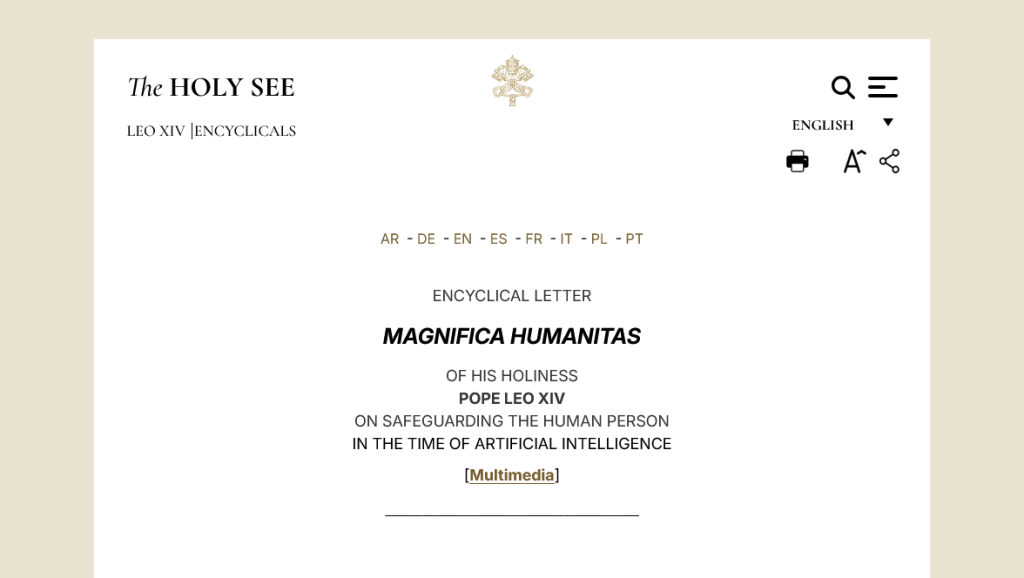
Recently the Roman Catholic Pope Leo XIV caused some excitement because his first Encyclic is on AI.
Whether you’re for or against the Pope doesn’t matter. If somebody high ranking as he is, develops ideas on a certain subject, it might always be interesting to know what he’s thinking about it.
Some people think it’s weird that a pope talks about AI, but it is not. AI could have a huge social impact, and religion deals a lot with social relations, therefor it is obvious that Leo XIV considers it important that the Roman Catholic church develops ideas about it.
The only odd thing about this Encyclic is, that it is not available in Latin, although the title is in Latin: Magnifica Humanitas. At the moment it exists in 8 language versions: Arabic, German, English, Spanish, French, Italian, Polish and Portugese.
These are the links for the documents: AR – DE – EN – ES – FR – IT – PL – PT
It will take a year or two before we finally grasp what AI really is capable of, and what not.
Nobody has to doubt that the current claims are exaggerated, but in the meantime we try to be as good informed as possible.
As I have written earlier, here and elsewhere, as a translator we all use AI in some form since some years. I don’t know when it exactly started. It’s difficult to pinpoint the moment, because it was a gradual evolution in the way our software became smarter in the way it combined terminology databases and previous translations.
The word ‘intelligent’ is not, however, the way I would describe it. The software, also the so-called Artificial Intelligence, gives sometimes unexpected results, but always shows a lack of intelligence, understanding and logic. It only does seem so superfluously.
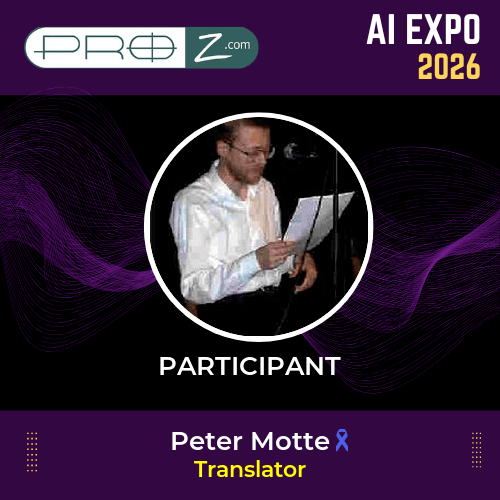
During the AI Expo 2026, organized by Proz.com, some speakers gave some insightful talks showing how AI lacks in-depth knowledge and mastering of language and translation.
My most popular message to date on LinkedIn mentioned the problem of working on AI generated translations: it is very exhausting, and the main problem is that it takes more time than the managers seem to think.
I’m not the first translator who says that an AI generated target sentence often has to be rebuild from scratch. Not only because of mistakes, but primarily because the mistakes are spread in such an odd way in the sentence, that it costs more time to stick to correcting the mistakes in the sentence, than to translate from scratch.
If you take the AI translation as a base to work from, you have to read and reread the source and compare it again and again with the target, because the content of the original can be ordered completely different in the target. If the translator wouldn’t do that, the result could be difficult to read, and wouldn’t even sound as the target language. Hence the extra work.
It’s one of the major disappointments about AI translations. I think we’ve hit the limit of gain in time that automation can give us.
Lately an agency asked me to check translations, and they wanted to pay me per “hits”.
A “hit” is a text segment that contains a number of words.
However, they can’t tell me how many words there will be per hit, nor can they tell me how many words there will be in total and how much the payment in total would be.
Not only is the rate per hit what you normally get per word, but you don’t know whether it’s for 1 word, 2, or maybe even 7 or 10.
The translator will have to judge the accuracy of some translated sentences and grade them based on how much the meaning of the source is transferred to the translation. It was for around 5000 hits, which could be anything from 5.000 to 50.000 words.
The contact person wrote me a hit “usually consist of short sentences”. So, the final result will be closer to 50.000 words than 5.000 words.
I have, of course, declined the offer, on the grounds that a) the price was too low, and b) it’s impossible to know the workload.
a) Too low, because this kind of work is usually underestimated by the managers. It takes much more time than expected once mistakes and changes crop up.
b) It’s impossible to know how much hours I would spend on it. The minimum of 5.000 words means at least 10.000 words have to be read, which is approximately 40 fully printed pages. If there is nothing to be changed, even checking whether it’s correct is going to take at least two hours. But if it turns out to be 50.000 words, and things have to be changed, it could mean at least 2 days of work. That means it’s impossible to plan such work.
If they don’t come up with a serious price per word instead of per hit, and if they don’t tell me the amount of words, this is impossible to plan. Whether you are allowed to work at your own pace or not, doesn’t matter. The pay is far too low anyway. Moreover, accepting such offers leads to unfair competition with better paying clients.



 Vertaalbureau MOTTE