Vertaalbureau MOTTE werd opgericht in 1997. Translation Agency MOTTE is founded in 1997. Le bureau de traductions MOTTE est fondé en 1997. Das Übersetzungsbüro MOTTE wurde 1997 gegründet.
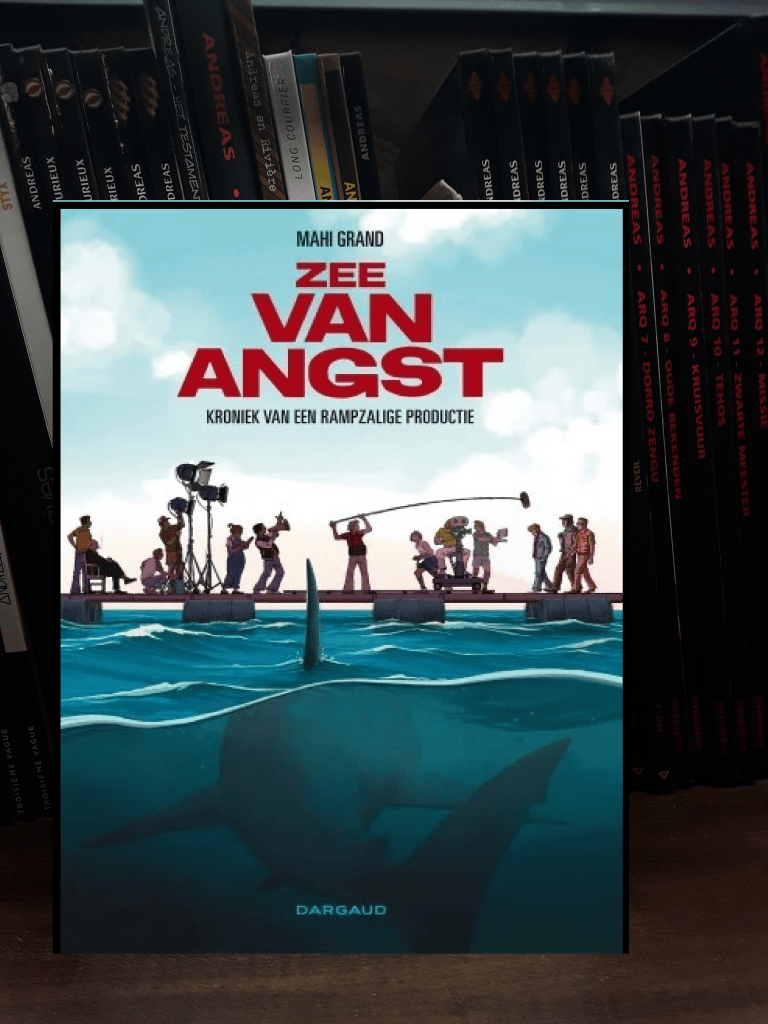
Eentje is geentje, dus deed ik er nog een: Zee van Angst door Mahi Grand, over het draaien van Jaws door Steven Spielberg. Ook deze keer voerde ik alleen maar de definitieve controle uit van de Nederlandse tekst.
De oorlog van Audrey n’était que le début, et j’ai aussi eu l’occassion de corriger le néerlandais de Zee van Angst door Mahi Grand, une BD sur le tournage de Jaws, le film de Steven Spielberg.
De oorlog van Audrey was only the beginning. I was also asked to check the Dutch version of Zee van Angst door Mahi Grand, the making of Jaws, the movie by Steven Spielberg. Also this time I had to check whether the language was all right.
Der Krieg von Audrey war erst der Anfang. Ich wurde auch gebeten, die niederländische Fassung von Zee van Angst von Mahi Grand zu überprüfen, dem Buch über die Entstehung von Der weiße Hai (Jaws), dem Film von Steven Spielberg. Auch diesmal sollte ich prüfen, ob die Sprache in Ordnung war.
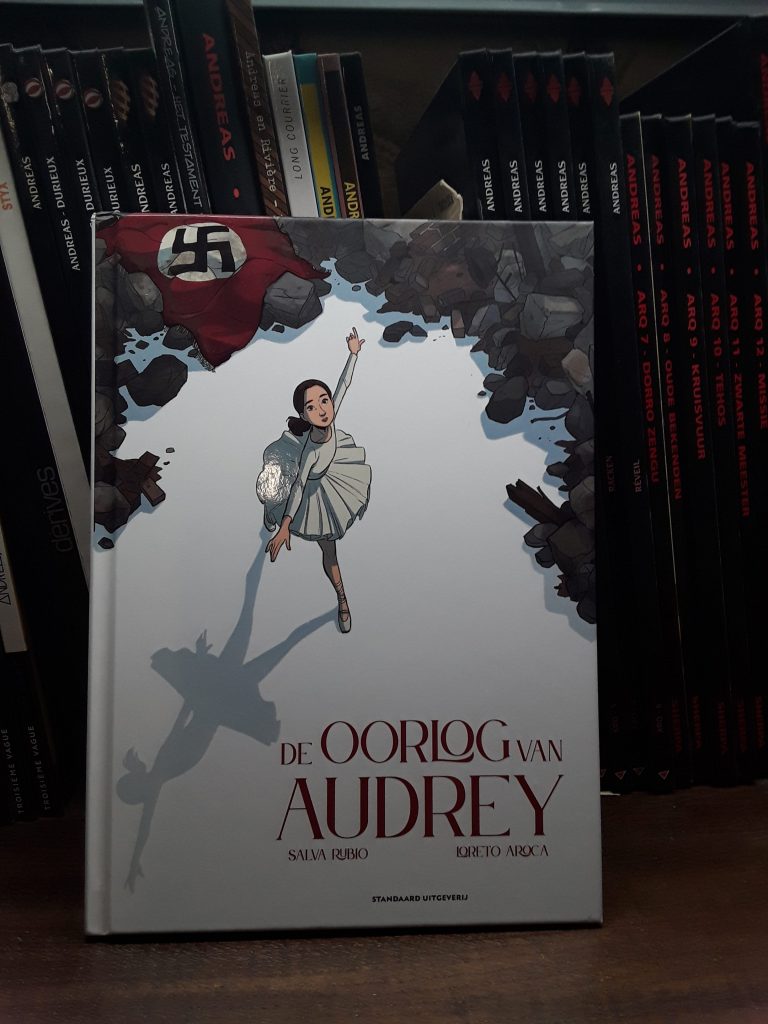
Het is lang geleden, maar eindelijk kon ik nog eens aan een stripalbum meewerken. Deze keer was het De oorlog van Audrey door Salva Rubio en Loreto Arcora. Ik voerde alleen maar de definitieve controle uit van de Nederlandse tekst.
Dans le passé j’avais souvent l’occassion de corriger le néerlandais de bd‘s, et maintenant c’est passé de nouveau. Cette fois-ci c’était De oorlog van Audrey de Salva Rubio et Loreto Arcora.
In the past I often got the chance to work on comics. This time I was asked to check the Dutch version of De oorlog van Audrey by Salva Rubio and Loreto Arcora. I had to check whether the language was all right.
n der Vergangenheit hatte ich oft die Gelegenheit, an Comics mitzuarbeiten. Diesmal wurde ich gebeten, die niederländische Version von De oorlog van Audrey von Salva Rubio und Loreto Arcora zu überprüfen. Ich sollte kontrollieren, ob die Sprache in Ordnung war.
Based on experience my colleague Markéta Brožová Hanelová said: “As for interpreting, I don’t think this profession will be easily erased, but similarly to translation, the developments are not driven by the rising AI-translation quality, but rather by clients willing to take risks in exchange for huge savings.”
A recent example of errors by AI is “Ich have Erfahrung mit Didaktik und Sprachlernmaterialien”. “I have” was translated by “Ich have” instead of “Ich habe”.
Some people think the AI does that to mark it as an AI translation. But those markings use special combinations of successive synonyms, not mistakes. It’s a mystery why it came up with “Ich have”.
A translation with a CAT tool or even with MT wouldn’t do that, because what you have entered correctly in CAT or MT will be reproduced correctly. AI is trained on an enormous amount of source material, and should not come up with “Ich have”. The volume of material would average out mistakes like that. Theoretically, that is.
You could argue that the blunder is easy to notice, but there are a few problems.
First of all, the types of mistakes AI makes are clearly unpredictable. It could be anything, and therefore it demands extra attention. Not only are there seemingly easy to notice problems, but you could also be tackled by mistakes in specialised vocabulary. And that’s tricky business.
Secondly, the user cannot trust AI if one of the two languages is unknown to him. You still have to be good in the source and the target language, because otherwise you’re going to miss errors. And on top of that, you also have to know the specialised vocabulary in both languages, which is especially treacherous because different terms might superficially be the same, whereas they aren’t in reality.
Basically all problems stem from the fact that AI does not reason, but gambles when it chooses words. It’s based on the most frequent occurrences of word combinations, not on the meaning, because it doesn’t understand things.
It are difficult times to find new clients, and the volume from older clients tends to diminish too.
Therefore I asked one of them whether I got the jobs during August because my colleagues were on a vacation, as I started to ask myself if I did something wrong, or whether the quality of my work went down.
The involved project manager answered:
“I can’t tell for other PMs, but for me personally, you are one of my first choices 😊 You reply quickly, consistently deliver good-quality translations, you’re flexible when it comes to deadlines, and your rate is competitive. So the recent jobs weren’t simply because other translators were on vacation – I’m very happy to work with you and will continue reaching out whenever I have suitable projects for you.
Best regards,
Barbara S.” (full name deleted for privacy reasons)
I translate for them from English to Dutch, and usually it’s about heavy mobile equipment.
Kürzlich sorgte der römisch-katholische Papst Leo XIV. für einiges Aufsehen, weil seine erste Enzyklika sich mit KI beschäftigt.
Unabhängig davon, ob man für oder gegen den Papst ist, spielt das keine Rolle. Wenn jemand mit einer so hohen Stellung wie er Ideen zu einem bestimmten Thema entwickelt, kann es immer interessant sein zu wissen, was er darüber denkt.
Manche Menschen finden es merkwürdig, dass ein Papst über KI spricht, aber das ist es nicht. KI könnte enorme gesellschaftliche Auswirkungen haben, und Religion beschäftigt sich in hohem Maße mit sozialen Beziehungen. Daher ist es naheliegend, dass Leo XIV. es für wichtig hält, dass die römisch-katholische KircheIdeen und Positionen dazu entwickelt.
Das einzig Merkwürdige an dieser Enzyklika ist, dass sie nicht auf Latein verfügbar ist, obwohl der Titel auf Latein lautet: Magnifica Humanitas. Derzeit existiert sie in acht Sprachversionen: Arabisch, Deutsch, Englisch, Spanisch, Französisch, Italienisch, Polnisch und Portugiesisch.
Hier sind die Links zu den Dokumenten: AR – DE – EN – ES – FR – IT – PL – PT
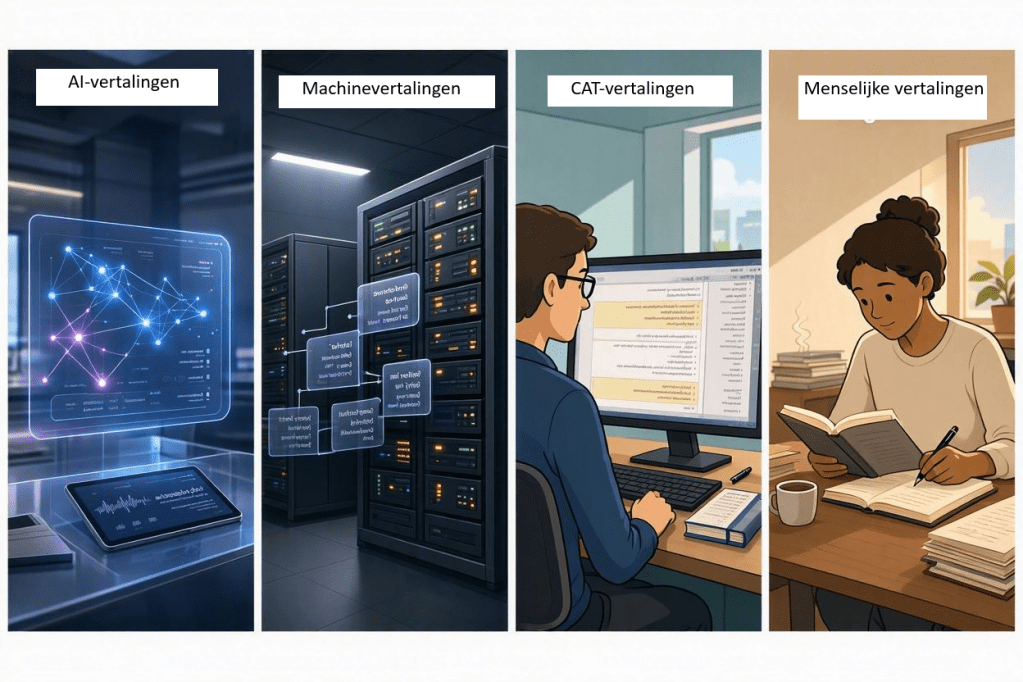
Ons uitgangspunt is altijd menselijke vertalingen in onze moedertaal, om te garanderen dat het merk van de klant ook in de streek van de doeltaal relevant blijft voor de doelgroep.
Ook vertalingen met CAT kunnen daarvoor worden ingezet, en regelmatige klanten kunnen we daarmee tijdwinst geven die niet geëvenaard wordt door MT- en AI-vertalingen. Bovendien laten AI-vertalingen vaak op subtiele wijze te wensen over, waardoor ze geen tijdwinst opleveren, zelfs in vergelijking met CAT- en MT. Er moet immers altijd worden gecontroleerd, geverifieerd en gecorrigeerd.
Er moet zeker rekening mee worden gehouden dat vertalingen doorgaans vertrouwelijk materiaal bevatten, zoals contracten, productgegevens en informatie over leveranciers- en klantenrelaties. Het is daardoor onverstandig die aan AI toe te wijzen. Dat ontsnapt gemakkelijk aan de controle.
Toch voeren we soms ook proeflezen uit van AI-vertalingen die door de klant worden geleverd. Het risico voor lekken door het gebruik van AI berust dan bij de klant, en hij is beter geplaatst dan wij om te besluiten welke gegevens vertrouwelijk zijn en welke niet.
Het is dus niet zo dat we categoriek afwijzen om aan AI-resultaten te werken, al weten we uit ervaring dat AI in het totaalproces van het vertalen geen meerwaarde oplevert, niet wat betreft tijdwinst, en niet wat betreft kwaliteit.
De rooms-katholieke paus Leo XIV heeft eind mei 2026 wat commotie veroorzaakt door zijn eerste encycliek. Daarin heeft hij het over kunstmatige intelligentie (KI, ook wel AI: artificiële intelligentie).
Als iemand met zo’n hoge positie als de paus spreekt over AI, is het altijd de moeite waard om te weten wat zijn ideeën erover zijn.
Er zijn mensen die het bizar vinden dat een paus het over KI heeft, maar dat is helemaal het geval niet. KI heeft een belangrijke sociale invloed, en aangezien religie zich in de eerste plaats om sociale relaties bekommert, is het normaal dat Leo XIV het belangrijk acht dat de kerk zich ermee bezighoudt.
Echt bizar is dat de encycliek wel een Latijnse titel heeft, nl. Magnifica Humanitas, maar dat er geen Latijnse versie van de hele tekst bestaat. Er is er ook nog geen in het Nederlands. Wij verwachten die vertalingen wel, maar op dit moment zijn er nog maar acht versies: Arabisch, Duits, Engels, Spaans, Frans, Italiaans, Pools en Portugees.
Dit zijn de links naar de documenten: AR – DE – EN – ES – FR – IT – PL – PT
Le pape catholique Léon XIV a causé une petite agitation avec sa première encyclique, parce qu’il s’agit de l’IA.
Quand quelqu’un occupant une position élevée comme le pape élabore des idées sur un sujet, c’est toujours intéressant de savoir ce qu’il pense.
Il y a des gens qui pensent que c’est bizarre que le pape parle d’IA, mais ça n’est pas le cas. L’IA va avoir un impact social énorme, et parce que la religion s’occupe des relations sociales, c’est normal que Léon XIV trouve important que l’Eglise se forge une idée à ce sujet.
La seule chose qui est bizarre, c’est que l’encyclique n’existe pas en latin pour l’instant. Mais le titre est en latin : Magnifica Humanitas. Pour le moment il y a seulement huit versions : arabe, allemand, anglais, espagnol, français, italien, polonais et portugais.
Voici les liens vers les documents : AR – DE – EN – ES – FR – IT – PL – PT
Recently the Roman Catholic Pope Leo XIV caused some excitement because his first Encyclic is on AI.
Whether you’re for or against the Pope doesn’t matter. If somebody high ranking as he is, develops ideas on a certain subject, it might always be interesting to know what he’s thinking about it.
Some people think it’s weird that a pope talks about AI, but it is not. AI could have a huge social impact, and religion deals a lot with social relations, therefor it is obvious that Leo XIV considers it important that the Roman Catholic church develops ideas about it.
The only odd thing about this Encyclic is, that it is not available in Latin, although the title is in Latin: Magnifica Humanitas. At the moment it exists in 8 language versions: Arabic, German, English, Spanish, French, Italian, Polish and Portugese.
These are the links for the documents: AR – DE – EN – ES – FR – IT – PL – PT
Some people claim they translate tens of thousands of words per day, thanks to the use of AI.
But how strong are those claims actually?
I don’t mean those people are lying. I mean “What do they actually call a translation?”
Recently I got a telling example of a job I did myself: 166 000 words in two days! I’m not kidding you. It means I did over 83 000 words PER DAY.
But here’s the thing: it were only 9 500 words to be checked, of course spread over several sentences (or translation units, as we call that in the translation business). In those source sentences words originally written in caps were replaced by tags. The only thing I had to do, was replacing the words in the translation by those tags.
That means the 166 000 words had already been translated. Only some of them had to be replaced.
I needed 2 days for that job, which means I did almost 5000 words per day. The tricky part was the tags had to end up in the right position and they had to fit in the grammatical structure. Because of that, the translation sometimes had to be rephrased.
It shows that claims of tens of thousands of words translated per day don’t tell us anything if we don’t get a detailed analyses of the work. How much if the original words have to be translated? How much can be skipped entirely? How many translation units only demand a partial translation or retranslation?
We have to be careful to take bold claims about huge translation outputs at face value, because anyhow, a human translator is not able to do much more than 2500 or 3000 words per day from scratch, with or without AI, or MT as we call it in the translation business.