Learning using AI and computers in general tends to be cutting corners and diminishing the effort one has to do. Because of it the learner has less direct experience with the thing he learns, which means he doesn’t learn as well. Maybe he notices he understands the subject, but the question is: will he remember enough of it? Will he actually “gain” something with it?
I have been learning Japanese by using software, offline and online, and although the learning process went smooth, my feeling was that I hadn’t learned anything which helped me in real situations.
Obviously, real situations are less standardized than a computer setting tends to be, and that’s why there isn’t enough variety in the learning process. The learning result is therefore not elastic enough to apply in real situations.
AI is everywhere. The odd thing is it looks to me as if people just got recently aware of it although as a translator we have been using it for years. The translation systems became gradually more clever. Because of that, there’s nothing new to it. Unfortunately, what isn’t new either, is the simplistic views held by outsiders on automation. Only yesterday I was in touch with somebody who thought it was possible to translate 400 pages for a mere 200 euro’s from English to Dutch. Did they really not see that 0.50 euro’s/page isn’t feasable for any system, however automated and advanced it is? But the real problem is some believe you can do away with translators altogether. Lately I found a website of one of my endclients, which obviously didn’t send all his texts via my agent to me, because there was a mistake on the home page, even in bold text. An adverb was treated as a noun. It’s a word, or rather a phrase, which is very tricky in Dutch because of the spelling differences for the two meanings. I was flabbergasted and researched all the work I had already done for them, and didn’t find it in any file. It was clearly something they had done by using MT or AI. And, of course, the automated systems didn’t notice the differences. I even noticed a second mistake, which also was the result of automated translation systems, in that case a problem by using a CAT tool. Although such systems can be very useful, they often hide differences which pop up because pieces of translations are glued together. But in changing the lingustic context by making new sentences putting together parts of old sentences or combining parts of old sentences with other words, those parts often have to be changed. Worse is that it was on a website which promotes judicial actions, and I wonder how people are going to trust a company offering that kind of actions if you see mistakes on the home page. Cutting out the human in the loop causes mistakes by which you lose clients, revenue and support.
Je wordt wel eens uitgedaagd om te controleren of AI vertalen aankan.
Een buur zag me onlangs dubben op: “Dort gibt es jetzt die aktuellen Modellhighlights.”
Ik had als oplossing aanvankelijk: “Daar zijn al de actuele modelhightlights.”
Die “highlights” klinkt misschien wat vreemd, maar dat is taalgebruik in het milieu van de doelgroep. Vandaar. Maar ik had een probleem met de zin: hij kon worden geïnterpreteerd alsof hij betekende dat “alle modelhighlights” er waren, maar “al” was hier een bijwoord van tijd.
Het kostte een half uurtje voor ik met mijn oplossing kwam (niet dat ik ondertussen niets anders deed): “De actuele modelhighlights zijn daar al.”
Het was gewoon een kwestie van een ander zinsdeel vooropzetten. De suggestie van mijn buur, om “al” te vervangen door “reeds”, wees ik af: niet vlot genoeg, en zelfs wat archaïsch. “Nou,” zei hij, “met AI had je het in een wip opgelost.”
Dat was natuurlijk een uitdaging, en dus stopte ik het in een automatische vertaalgenerator met AI.
Die kwam eerst aan met: “Daar vindt u nu de actuele modelhoogtepunten.”
Hij had “gibt es” vertaald met “vindt u”, wat niet onaardig is, maar hoe dan ook niet echt wat er staat. Dat de “highlights” “hoogtepunten” werden, wou ik door de vingers zien, maar het toonde in elk geval dat de AI het taalgebruik van de scene niet kent. Je kunt hem dat misschien wel leren, maar als ik hem alles moet leren, kost het me meer tijd dan als ik het zelf doe.
Toen ik het hem nog eens liet vertalen, kreeg ik: “Daar zijn nu de huidige modelhoogtepunten te vinden.”
Logischerwijs keerden die “hoogtepunten” terug, maar “gibt es” was nu “zijn (…) te vinden”, wat al bij al een achteruitgang is. Het blijft een stijlfout, omdat die “gibt” nogal inhoudsloos is, en dan vertaal je het best niet met ogenschijnlijk inhoudelijke woorden, terwijl het hier hoogstens de functie van een koppelwerkwoord heeft dat onderwerp, tijd en plaats met elkaar verbindt. Da’s een redenering die de AI, waarin “intelligentie” eigenlijk misplaatst is, niet kan maken.
“Jetzt” was in beide gevallen vertaald met “nu”, wat op zich wel goed is, maar wat ik opzettelijk had vermeden om de klemtoon minder op de onmiddellijkheid van de beschikbaarheid van de modellen te leggen. Er kon immers altijd iets misgaan met de leveringen, en bovendien was het een vertaling van een Duits blad dat zich erg richt op de Duitse markt waar producten afkomstig uit Duitse fabrieken worden verspreid. Aangezien ik naar het Nederlands vertaal, is het mogelijk dat er vertraging bij de uitlevering naar Nederland en België optreedt, zodat de liefhebber die naar zijn verkoper rent misschien voor niets de zweetdruppels op het voorhoofd parelen. Liever geen valse verwachtingen scheppen, denk ik dan, realistische verwachtingen maken tevreden klanten. Nog een redenering die AI niet kan maken. En die je hem ook niet kunt aanleren, of “jetzt” wordt altijd “al”. Wat ook niet juist is.
O ja, waarom schreef ik dan “daar” en niet “er”? Omdat “daar” sterker de nadruk legt op de terugverwijzing naar het antecedent in de voorgaande zin, terwijl “er” dat zou wegmoffelen. Dat was een verwijzing die ik er nou wel wou inhouden, in tegenstelling tot die “nu”, waarvan ik de directheid had verborgen.
Maar er is nog iets: hoe je ook telt, met woorden of met lettertekens, de AI kwam altijd met langere oplossingen aandraven. Nogal typisch: de kletsbarakken kunnen wel foutloze zinnen produceren, maar dat doen ze vaak door woordomhaal. Ze kunnen immers niet denken, en hebben geen enkel inzicht in de betekenis van de zin.
Dat heeft twee gevolgen: ten eerste had ik alle overwegingen die ik had gemaakt tijdens mijn vertaling, ook moeten maken als ik de AI had gebruikt, om de gebreken uit de vertaling te halen. En ik zou dus geen tijd hebben gewonnen.
En ten tweede ontstaat die woordomhaal doordat AI vermijdt foute zinnen af te leveren, zodat het allemaal goed oogt, terwijl het dat niet is. En dan bestaat het gevaar dat je die gebreken onbewust of onoplettend overneemt.
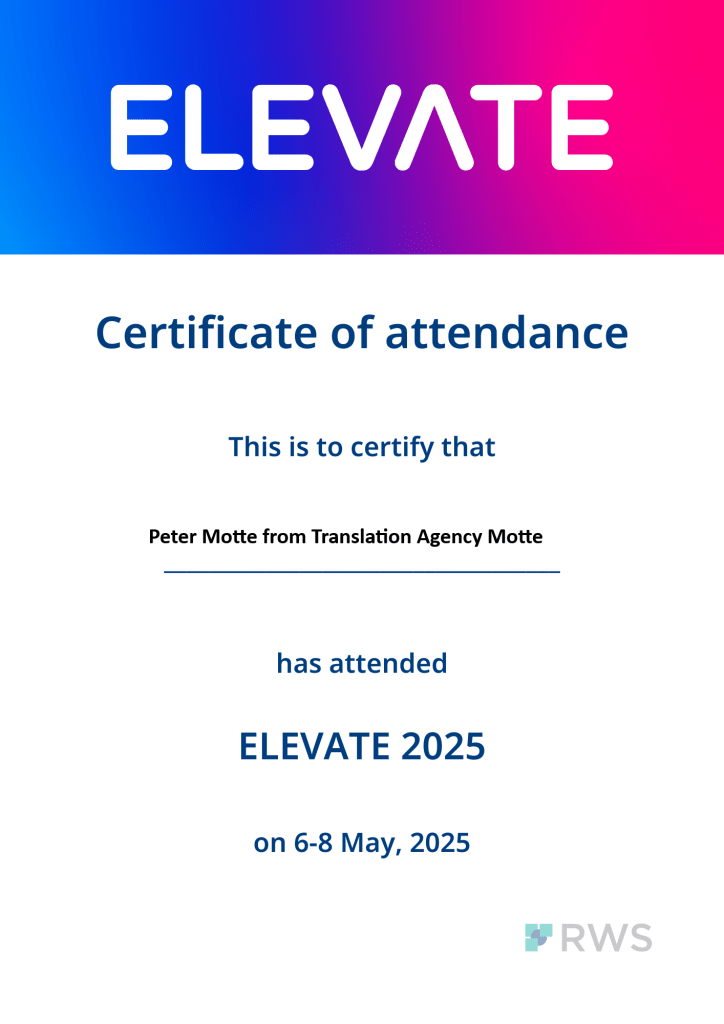
We attended the webinars organised by RWS during Elevate 2025 on the implication of AI on translation, and had some interesting talks with some of the other attendants.
It gave us the opportunity to stay in touch with the latest developments.
Artificiële intelligentie (AI) voor vertalen is niets nieuws.
Het vertaalvak is altijd al beïnvloed geweest door ICT, omdat het nu eenmaal over communicatie gaat. Vertalers waren bij de eersten die faxmachines op grote schaal konden gebruiken. We waren ook bij de eersten die pc’s toepasten, zelfs al was het alleen maar om ervoor te zorgen dat het afgeleverde werk er netjes uitzag. En we waren ook de eersten die pc’s gebruikten om er databases op te installeren om geautomatiseerde woordenboeken en spellingcontrole te gebruiken.
Een van de eerste voordelen die mij aansprak bij vertalen met computers, was dat we de lay-out van het oorspronkelijke document konden behouden. De dagen van velletjes papier met genummerde tekstblokken om het verband te leggen met de oorspronkelijke tekst, waren voorbij. De klant kreeg eindelijk een vertaald document zonder het risico tekst te verwarren, en dat hij vlot in zijn productketen kon introduceren.
Toen de computergeheugen groot en snel genoeg werden om brontekst en doeltekst van vertalingen op te slaan, konden we de voordelen oogsten van ons vroegere werk door de automatiseren wat we al decennia lang deden: vertalingen van gewijzigde documenten baseren op vertalingen van vorige versies. Maar deze keer moesten we geen stapels teksten meer doorploegen en overtikken. De computer deed dat deel van het werk voor ons, en wij konden ons concentreren op de nieuwe en gewijzigde delen en sneller een beter resultaat afleveren.
De jongste evolutie was de introductie van on of computerondersteund vertalen of CAT (van computer aided translation). Eenmaal die programma’s werden gebruikt, was het alleen nog maar een kwestie van tijd voor er programmaregels werden geïmplementeerd om bronmateriaal met allerlei soorten doelmateriaal te vergelijken, zodat het programma ons kon ondersteunen bij het aanpassen van de doeltekst.
Dat betekende onvermijdelijk dat er meer intelligentie in die programma’s werd geïntroduceerd, en dat leidde ten slotte tot wat we machinevertalingen, of MT (van machine translation) noemen.
Daarom begrijp ik de huidige hype over vertalen met AI niet. In feite IS MT vertalen met AI. MT-systemen gebruik vaak geen traditionele CAT als basis, maar traditionele CAT heeft doorgaans wel MT-elementen geïmplementeerd zodat MT wordt gebruikt voor de voorbereiding van het definitieve werk van de vertaler om het proces te versnellen en tegelijk de fouten te vermijden die pure geautomatiseerde systemen maken.
MT werkt niet zonder MTPE: machine translation post editing. De vertaler voert een redactie na de machinevertaling uit. Op die manier werkt ook vertalen met AI. Het enige verschil tussen vertalen met AI en met MTPE is terminologisch: het zijn twee verschillende uitdrukkingen voor hetzelfde ding. Daarom is de enorme hype over AI bij vertalen niets meer dan een verschuiving in terminologie en soms ook in leveranciers: sommigen zeggen om klanten aan te trekken dat ze AI gebruiken, maar ze doen hetzelfde als wat de vertaalsector al minstens tien jaar doet.
De term AI voor vertalen is meer een kwestie van marketing en windowdressing dan van een nieuwe, meer geavanceerde manier van werken.
Following the online AI Expo 2025 I went to a local introduction on AI in my home town. It was organised by the UNIZO, a Belgian association of Small to Medium-sized Enterprises. It’s the biggest network for entrepreneur and self-employed persons in Flanders and Brussels. They are at https://www.unizo.be/ I have to admit that the introduction was far too general to be of any use for me.
Artificial Intelligence (AI) in translation is nothing new.
The craft of translation has always been influence by ICT, because it’s all about communication. We were amongst the first who could use fax machines. We were amongst the first who could use pc’s, even if it was only to have an output which looked more neat. And so we were also the first who used pc’s to install databases on them and to be able to use automated dictionaries and spelling checkers.
One of the first benefits I like about translating using a computer, was that we could preserve the layout of the original document. The days of numbering blocks of text to make clear which part of the translation was related to which part of the original text, were gone. The client finally got a document which he could incorporate in his work flow and product chain without much ado.
When computer memories became big and fast enough to store source and target of previous translations, we could start reaping the benefits of our previous work, by automating what we had already been done for decades: found translations of reviewed documents on the translations of the original documents. But this time we didn’t have to plough through huge stacks of material and type it over. The computer did part of the work for us, and we could deliver faster a better result.
That last evolution was the introduction of computer aided translation, or CAT. Once those programs were used, it was simply a matter of time before we could implement logic to compare source material with target material of various kinds, so that the program could support us to amend the target.
Inevitable that lend to an increasing intelligence of the programs, and finally to what we call machine translation, or MT.
That’s why I don’t understand the hype about translating with AI. As a matter of fact MT IS translating with AI. MT systems often don’t use the traditional CAT tools as their fundamental work system, and traditional CAT tools have implemented some MT elements to make it possible to use MT to prepare for the definitive work by the translation to speed up the work and at the same time to avoid mistakes by the automated systems.
MT doesn’t work without MTPE: machine translation post editing. The translator does the post editing of the texts produced by MT. That is the way translation with AI works. The only difference I see between translation with AI and MTPE is the terminology: it are two different expressions to mention the same thing. Therefore the huge hype about AI in the field of translation is nothing more than a shift in providers: some say they use AI to draw clients, but they’re doing the same thing that the translation business has been doing for several years now. AI in translation is more about marketing and window dressing than about offering a new, more advanced way of working.
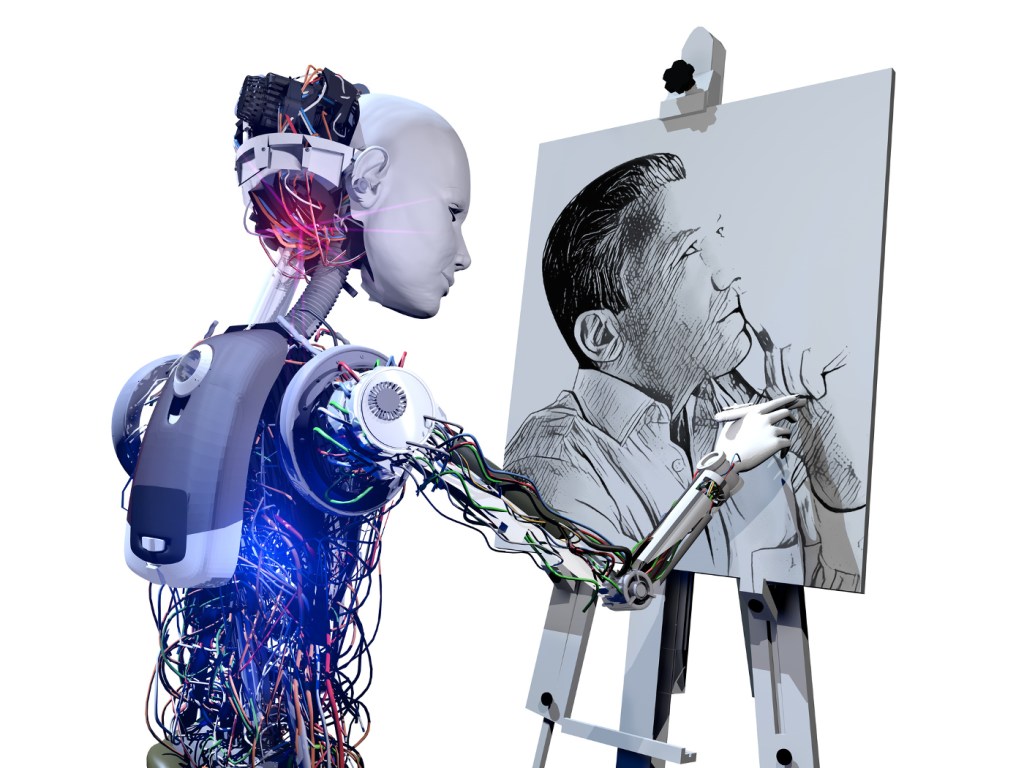
AI can be creative in certain ways, though its approach to creativity is very different from human creativity. When we talk about creativity in AI, it often comes down to how well an AI can generate new ideas, solve problems in novel ways, or produce art, music, or writing that feels fresh or innovative. However, its creative output is typically bound by the data and patterns it has been trained on, as well as the algorithms that guide its process. Here’s a closer look at what AI creativity involves:
1. Generative Creativity
Examples: AI-generated art, music, and writing are among the most visible examples of generative creativity. Models like DALL-E, GPT, and others use vast datasets of images, text, and audio to create something new by combining and transforming existing patterns in unique ways.
Mechanism: Generative models use sophisticated algorithms to synthesize data, but they’re not truly creating from scratch or from personal inspiration; instead, they combine elements learned from training data. So, while the output may look creative to us, it’s a reconfiguration of prior data rather than an entirely novel concept.
2. Problem-Solving and Innovation
Examples: AI algorithms can help discover new drugs, suggest innovative materials, or optimize systems in ways that weren’t obvious to humans. AI excels at exploring many possibilities at once, especially in structured fields like mathematics, physics, and chemistry.
Mechanism: Using methods like reinforcement learning or evolutionary algorithms, AI can “explore” solutions by trial and error or adapt previous successful strategies to new challenges. In many cases, the solutions AI finds can surprise or even inspire human researchers, as they may break with traditional thinking or assumptions.
3. Augmenting Human Creativity
Examples: AI can serve as a collaborator in creative fields, helping artists, musicians, and writers experiment with new ideas, overcome creative blocks, or find unexpected directions. For instance, musicians might use AI to generate a melody based on a given style or genre.
Mechanism: In this role, AI acts more like a tool that expands the human creative process, giving artists and creators a starting point, reference, or unexpected twist. The final creative control and decision-making, however, remain with the human.
4. Limitations in True Creativity
Context and Intent: Human creativity is driven by emotions, experiences, and intentions, all of which give depth and meaning to creative work. AI doesn’t experience these things; it operates without consciousness, intuition, or intent.
Originality: While AI can generate outputs that look original, it isn’t creating from a true sense of originality; it’s generating based on patterns and probabilities in its training data. Even when it makes surprising connections, they lack the subjective motivation that often drives human creativity.
In Summary
AI can generate creative outputs by recombining existing elements in innovative ways, and it can even inspire or collaborate with humans. However, because it lacks true consciousness, personal experience, and emotional depth, AI’s creativity differs from human creativity in significant ways
The creativity of AI is both fascinating and transformative, especially as we begin to see machines take on tasks that were traditionally exclusive to human imagination and ingenuity. AI’s approach to creativity is rooted in its ability to process vast datasets, recognize patterns, and generate new combinations of ideas, images, or words. Unlike human creativity, which draws from personal experience, intuition, and often an emotional or cultural connection, AI creativity is based on algorithms, probabilities, and learned data structures. But as it evolves, AI is beginning to exhibit behaviors that are eerily reminiscent of human creativity, inspiring a new dialogue about what it means to “create.”
For example, generative models like GPT-4 and DALL-E (which creates images from text prompts) showcase AI’s ability to produce art, music, literature, and design concepts. These systems don’t “feel” creativity as humans do, but they mimic it through a process called “generative synthesis,” blending learned elements to produce something original within a given framework. This approach has led to surprising, sometimes profound results, such as AI-written novels, original paintings, and new styles of music.
One powerful aspect of AI creativity is its capacity for collaboration. Human artists, writers, and scientists increasingly use AI as a partner, integrating its suggestions or novel outputs into their own work. In these hybrid environments, AI offers humans fresh ideas and perspectives that may not arise from a purely human-centered creative process. This symbiosis—where AI can suggest unanticipated plot twists in a novel or offer design combinations never before considered—hints at a future where creativity is shared between human and machine.
Still, AI’s creativity raises ethical and philosophical questions. Can an algorithmically generated piece be truly considered art? Who owns the creative rights? And what happens when AI begins to mimic human creativity so closely that it’s hard to tell the difference? These questions challenge our traditional notions of authorship, originality, and even the purpose of creativity itself.
As AI continues to develop, its role in creative fields could fundamentally change the landscape of human culture. Whether it remains a tool or grows into something closer to a collaborator, AI’s creativity will no doubt drive innovation and broaden our understanding of what creativity can be.



 Vertaalbureau MOTTE