Vertaalbureau MOTTE werd opgericht in 1997. Translation Agency MOTTE is founded in 1997. Le bureau de traductions MOTTE est fondé en 1997.
Auteur: Peter Motte
Over ons
"Voor de vertaler is meedenken met de klant onmisbaar om een efficiënte link met de markt te leggen."
Met Vertaalbureau MOTTE lever ik vertalingen van allerlei aard aan bedrijven om hun communicatie met hun klanten soepeler en duidelijker te laten verlopen.
We gebruiken daarvoor diverse technologieën, zowel oudere als nieuwe. Dat levert kostenbesparingen en flexibiliteit op.
Door mijn belangstelling voor wetenschappen en techniek studeerde ik eerst wat wiskunde en daarna talen. Als vertaler kan ik alle onderwerpen die me boeien combineren. Het is minstens even belangrijk om de technologie en het bedrijfsleven te begrijpen als talen te kennen.
Als liefhebber van literatuur publiceerde ik een redelijke bibliografie van poëzie en "techneuten-literatuur" zoals sciencefiction. Dat was een goede oefening om technische teksten in een vlotte taal om te zetten.
Op mijn webpagina en blogs kunt u getuigenissen vinden van klanten zoals BTC voor chemische vertalingen, P&O voor administratieve teksten, en Ballon Media voor het frivolere werk: stripverhalen.
Mijn websites en blogs onderhoud ik zelf. Tijdens mijn wiskundestudies kreeg ik IT-initiaties. Die achtergrond helpt om de hedendaagse vertaalsystemen te gebruiken, omdat ze allemaal op databasemanagement steunen en documentformaten een grote rol spelen. En om de IT-veiligheidsproblemen te begrijpen.
De lijst getuigenissen zou langer kunnen zijn, maar zelfs zonder geheimhoudingsclausules vind ik discretie belangrijk. Ik weet vaak al vroeg welke producten op de markt komen, of aan welke veranderingen een bedrijf werkt. En ik zou ook niet willen dat onze innovaties door een van de medewerkers van Vertaalbureau MOTTE worden gelekt.
Web page developed, translated and maintained by Peter Motte for Translation Agency Motte / Vertaalbureau Motte Abdijstraat 33 B-9500 Geraardsbergen Belgium e-mail: peter.motte@skynet.be
Following the online AI Expo 2025 I went to a local introduction on AI in my home town. It was organised by the UNIZO, a Belgian association of Small to Medium-sized Enterprises. It’s the biggest network for entrepreneur and self-employed persons in Flanders and Brussels. They are at https://www.unizo.be/ I have to admit that the introduction was far too general to be of any use for me.
Artificial Intelligence (AI) in translation is nothing new.
The craft of translation has always been influence by ICT, because it’s all about communication. We were amongst the first who could use fax machines. We were amongst the first who could use pc’s, even if it was only to have an output which looked more neat. And so we were also the first who used pc’s to install databases on them and to be able to use automated dictionaries and spelling checkers.
One of the first benefits I like about translating using a computer, was that we could preserve the layout of the original document. The days of numbering blocks of text to make clear which part of the translation was related to which part of the original text, were gone. The client finally got a document which he could incorporate in his work flow and product chain without much ado.
When computer memories became big and fast enough to store source and target of previous translations, we could start reaping the benefits of our previous work, by automating what we had already been done for decades: found translations of reviewed documents on the translations of the original documents. But this time we didn’t have to plough through huge stacks of material and type it over. The computer did part of the work for us, and we could deliver faster a better result.
That last evolution was the introduction of computer aided translation, or CAT. Once those programs were used, it was simply a matter of time before we could implement logic to compare source material with target material of various kinds, so that the program could support us to amend the target.
Inevitable that lend to an increasing intelligence of the programs, and finally to what we call machine translation, or MT.
That’s why I don’t understand the hype about translating with AI. As a matter of fact MT IS translating with AI. MT systems often don’t use the traditional CAT tools as their fundamental work system, and traditional CAT tools have implemented some MT elements to make it possible to use MT to prepare for the definitive work by the translation to speed up the work and at the same time to avoid mistakes by the automated systems.
MT doesn’t work without MTPE: machine translation post editing. The translator does the post editing of the texts produced by MT. That is the way translation with AI works. The only difference I see between translation with AI and MTPE is the terminology: it are two different expressions to mention the same thing. Therefore the huge hype about AI in the field of translation is nothing more than a shift in providers: some say they use AI to draw clients, but they’re doing the same thing that the translation business has been doing for several years now. AI in translation is more about marketing and window dressing than about offering a new, more advanced way of working.
AI can be creative in certain ways, though its approach to creativity is very different from human creativity. When we talk about creativity in AI, it often comes down to how well an AI can generate new ideas, solve problems in novel ways, or produce art, music, or writing that feels fresh or innovative. However, its creative output is typically bound by the data and patterns it has been trained on, as well as the algorithms that guide its process. Here’s a closer look at what AI creativity involves:
1. Generative Creativity
Examples: AI-generated art, music, and writing are among the most visible examples of generative creativity. Models like DALL-E, GPT, and others use vast datasets of images, text, and audio to create something new by combining and transforming existing patterns in unique ways.
Mechanism: Generative models use sophisticated algorithms to synthesize data, but they’re not truly creating from scratch or from personal inspiration; instead, they combine elements learned from training data. So, while the output may look creative to us, it’s a reconfiguration of prior data rather than an entirely novel concept.
2. Problem-Solving and Innovation
Examples: AI algorithms can help discover new drugs, suggest innovative materials, or optimize systems in ways that weren’t obvious to humans. AI excels at exploring many possibilities at once, especially in structured fields like mathematics, physics, and chemistry.
Mechanism: Using methods like reinforcement learning or evolutionary algorithms, AI can “explore” solutions by trial and error or adapt previous successful strategies to new challenges. In many cases, the solutions AI finds can surprise or even inspire human researchers, as they may break with traditional thinking or assumptions.
3. Augmenting Human Creativity
Examples: AI can serve as a collaborator in creative fields, helping artists, musicians, and writers experiment with new ideas, overcome creative blocks, or find unexpected directions. For instance, musicians might use AI to generate a melody based on a given style or genre.
Mechanism: In this role, AI acts more like a tool that expands the human creative process, giving artists and creators a starting point, reference, or unexpected twist. The final creative control and decision-making, however, remain with the human.
4. Limitations in True Creativity
Context and Intent: Human creativity is driven by emotions, experiences, and intentions, all of which give depth and meaning to creative work. AI doesn’t experience these things; it operates without consciousness, intuition, or intent.
Originality: While AI can generate outputs that look original, it isn’t creating from a true sense of originality; it’s generating based on patterns and probabilities in its training data. Even when it makes surprising connections, they lack the subjective motivation that often drives human creativity.
In Summary
AI can generate creative outputs by recombining existing elements in innovative ways, and it can even inspire or collaborate with humans. However, because it lacks true consciousness, personal experience, and emotional depth, AI’s creativity differs from human creativity in significant ways
The creativity of AI is both fascinating and transformative, especially as we begin to see machines take on tasks that were traditionally exclusive to human imagination and ingenuity. AI’s approach to creativity is rooted in its ability to process vast datasets, recognize patterns, and generate new combinations of ideas, images, or words. Unlike human creativity, which draws from personal experience, intuition, and often an emotional or cultural connection, AI creativity is based on algorithms, probabilities, and learned data structures. But as it evolves, AI is beginning to exhibit behaviors that are eerily reminiscent of human creativity, inspiring a new dialogue about what it means to “create.”
For example, generative models like GPT-4 and DALL-E (which creates images from text prompts) showcase AI’s ability to produce art, music, literature, and design concepts. These systems don’t “feel” creativity as humans do, but they mimic it through a process called “generative synthesis,” blending learned elements to produce something original within a given framework. This approach has led to surprising, sometimes profound results, such as AI-written novels, original paintings, and new styles of music.
One powerful aspect of AI creativity is its capacity for collaboration. Human artists, writers, and scientists increasingly use AI as a partner, integrating its suggestions or novel outputs into their own work. In these hybrid environments, AI offers humans fresh ideas and perspectives that may not arise from a purely human-centered creative process. This symbiosis—where AI can suggest unanticipated plot twists in a novel or offer design combinations never before considered—hints at a future where creativity is shared between human and machine.
Still, AI’s creativity raises ethical and philosophical questions. Can an algorithmically generated piece be truly considered art? Who owns the creative rights? And what happens when AI begins to mimic human creativity so closely that it’s hard to tell the difference? These questions challenge our traditional notions of authorship, originality, and even the purpose of creativity itself.
As AI continues to develop, its role in creative fields could fundamentally change the landscape of human culture. Whether it remains a tool or grows into something closer to a collaborator, AI’s creativity will no doubt drive innovation and broaden our understanding of what creativity can be.
In de voortdurend evoluerende wereld van vertalingen zijn hulpmiddelen essentieel geworden voor zowel professionele vertalers als amateurs. Van woordenboeken tot vertaalgeheugens en terminologiedatabanken hebben tools de efficiëntie en nauwkeurigheid van vertaalwerk aanzienlijk verbeterd. Ze helpen vertalers bij het vinden van de juiste termen, het behouden van consistentie en het vermijden van fouten.
9b De computer als hulpmiddel
De opkomst van computers heeft een revolutie teweeggebracht in het vertaalproces. Vertaalsoftware zoals CAT-tools (Computer Assisted Translation) biedt functionaliteiten zoals automatische segmentatie van teksten, fuzzy matching en suggesties op basis van eerder vertaald materiaal. Dit verhoogt niet alleen de snelheid van vertalingen, maar stelt vertalers ook in staat om consistentie te handhaven over grote hoeveelheden tekst.
9c De computer als vertaler
Met de opkomst van machinevertalingen of machine translation is de relatie tussen menselijke vertalers en machines veranderd. Moderne vertaalmachines, zoals neurale netwerkmodellen, maken gebruik van geavanceerde algoritmen en machine learning-technieken om teksten automatisch te vertalen. Hoewel deze systemen indrukwekkende resultaten kunnen behalen, blijven ze moeite hebben met nuances, contextuele interpretatie en culturele gevoeligheid.
De discussie over de effectiviteit van machinevertalingen gaat echter verder dan slechts de kwaliteit van de vertalingen. Menselijke vertalers brengen unieke vaardigheden en inzichten naar het vertaalproces die niet gemakkelijk kunnen worden gereproduceerd door machines. Ze begrijpen de nuances van taal, kunnen culturele subtiliteiten oppikken en zijn in staat om contextuele betekenissen te interpreteren op een manier die machines nog niet kunnen evenaren.
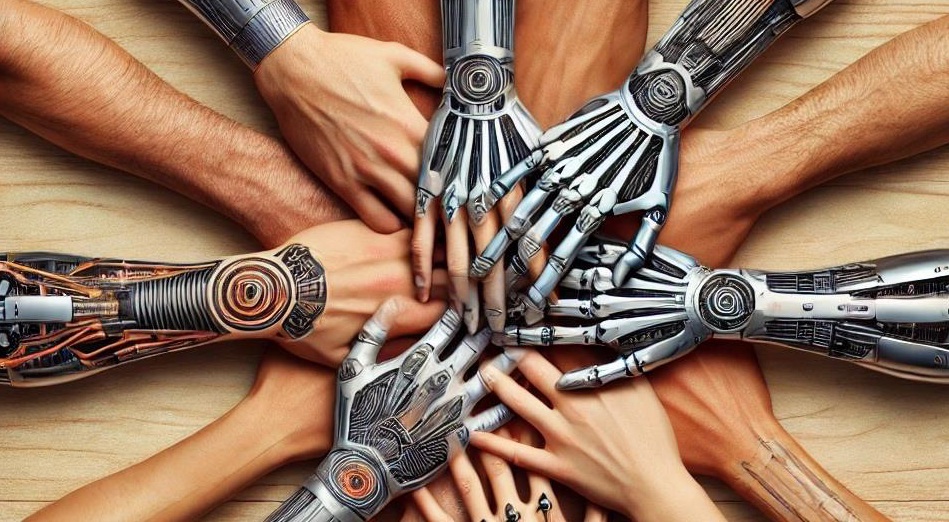
De toekomst van vertalingen ligt in een samensmelting van menselijke expertise en geavanceerde technologie. Terwijl machines blijven evolueren en betere vertaalresultaten produceren, zal de rol van menselijke vertalers zich wellicht verplaatsen naar taken die een dieper begrip van taal en cultuur vereisen, zoals redactie, revisie en creatieve vertalingen.
Hoewel machines een waardevol hulpmiddel zijn in het vertaalproces, blijft de menselijke vertaler onmisbaar voor het leveren van hoogwaardige vertalingen die recht doen aan de complexiteit en nuances van menselijke communicatie. De vertaler van de toekomst is misschien geen mens of machine, maar eerder een symbiotische combinatie van beide. Maar de vertaler heeft altijd het laatste woord.
Vertalen is niet alleen een kwestie van het omzetten van woorden van de ene taal naar de andere, maar ook van het overbrengen van betekenissen, nuances en culturele connotaties. Deze complexiteit wordt vaak weergegeven als twee basisdimensies: de letterlijke betekenis en de contextuele interpretatie. De letterlijke betekenis omvat de woord-voor-woord vertaling, terwijl de contextuele interpretatie rekening houdt met de culturele, historische en situatiespecifieke elementen die de betekenis van een tekst vormen. Een succesvolle vertaling balanceert deze twee dimensies om een accurate weergave van de oorspronkelijke boodschap te bieden.
8b Expliciet en impliciet
Een van de uitdagingen van vertalen is het omgaan met expliciete en impliciete informatie in de brontekst. Expliciete informatie wordt direct uitgedrukt, terwijl impliciete informatie tussen de regels door wordt geïmpliceerd. Het is de taak van de vertaler om beide soorten informatie nauwkeurig over te brengen, zelfs als de culturele context verschilt tussen de brontaal en de doeltaal. Het toevoegen van verklaringen kan helpen om impliciete aspecten van de tekst duidelijk te maken voor lezers die mogelijk niet bekend zijn met de oorspronkelijke cultuur of context.
8c Bewerking of parafrase
Bij het vertalen moeten vertalers soms kiezen tussen het bewerken van de tekst om deze beter aan te laten sluiten bij de doeltaal of het behouden van de oorspronkelijke formulering door middel van een parafrase. Bewerkingen kunnen nodig zijn om grammaticale, culturele of idiomatische verschillen te overbruggen, terwijl parafrases de originele boodschap behouden maar met andere woorden worden uitgedrukt. In beide gevallen kan het toevoegen van verklaringen helpen om de keuzes van de vertaler te rechtvaardigen en de lezer inzicht te geven in de nuances van de vertaalbeslissingen. Het toevoegen van verklaringen aan een vertaling kan de leesbaarheid en begrijpelijkheid verbeteren, vooral bij het omgaan met complexe culturele concepten of taalkundige subtiliteiten. Echter, overmatige verklaringen kunnen ook de stroom van de tekst onderbreken en het leesplezier verminderen. Het is dus de kunst van de vertaler om het juiste evenwicht te vinden tussen het overbrengen van de oorspronkelijke boodschap en het bieden van de nodige verklaringen om de tekst toegankelijk te maken voor een doelpubliek.